A new survey explores how holiday gift shoppers' struggles differ by age, and which generations turn to gift baskets as a solution.
We conducted the Gourmet Gift Baskets’ Holiday Gift-Giving Survey of 1,037 U.S. adults to better understand how shopping behaviors differ by generation. So we tried to answer a few questions:
- Which generation struggles most with holiday gift shopping?
- Are younger adults more likely to consider gift baskets for last-minute gifts?
- Who buys gift baskets, and why?
- What age group finds it hardest to buy gifts for others?
Key Insights
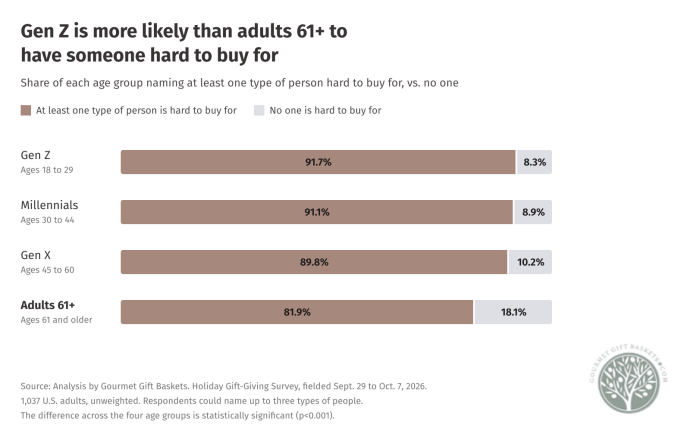
- Who struggles: Younger adults are more likely to have someone hard to buy for. 91.7% of Gen Z, 91.1% of Millennials, and 89.8% of Gen X named at least one hard-to-buy-for category, versus 81.9% of adults 61 and older. Adults 61 and older were more than twice as likely as Gen Z to say no one is hard to buy for (18.1% vs. 8.3%).
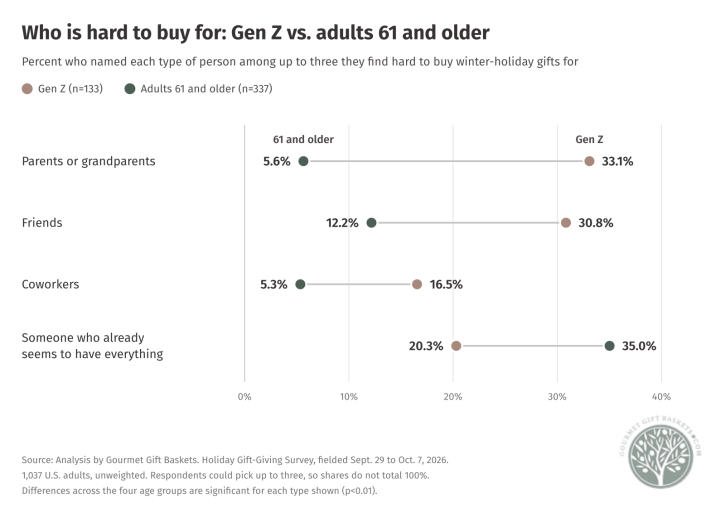
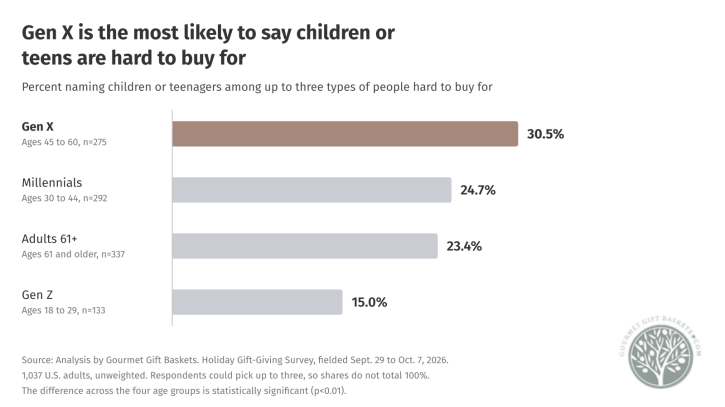
- Who they struggle with: Gen Z most often named parents or grandparents (33.1%) and friends (30.8%). Adults 61 and older most often named someone who already seems to have everything (35.0%). Gen X was the most likely to name children or teens (30.5%).
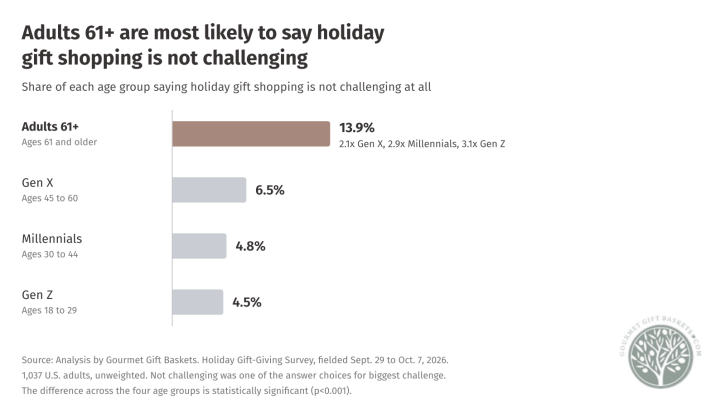
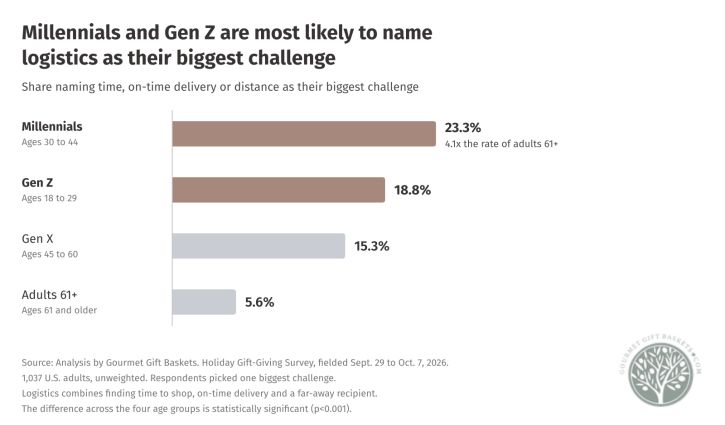
- What makes shopping hard: Budget was the biggest challenge for everyone under 61. Logistics, such as finding time or meeting delivery deadlines, was the biggest challenge for 23.3% of Millennials, 18.8% of Gen Z, and 15.3% of Gen X, versus 5.6% of adults 61 and older. Adults 61 and older were also the most likely to say shopping is not challenging (13.9%, vs. 4.5% to 6.5% of younger groups).
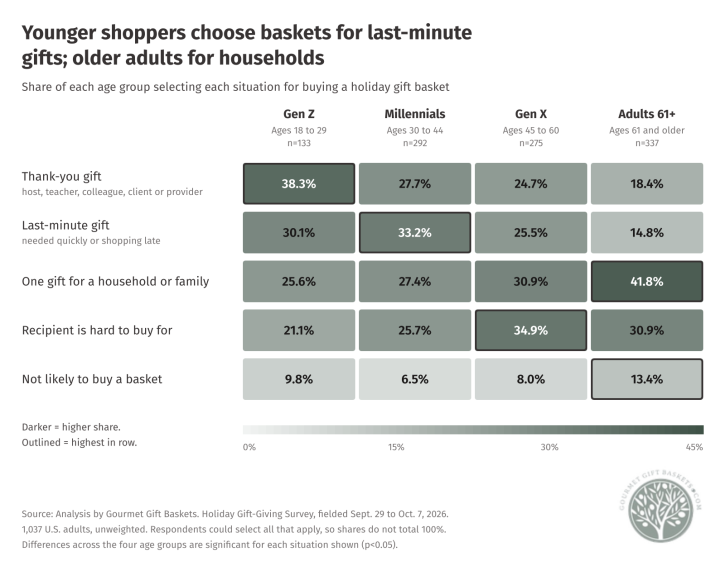
- Who considers baskets for last-minute gifts: Millennials (33.2%) and Gen Z (30.1%) are about twice as likely as adults 61 and older (14.8%) to say a last-minute gift is when they would buy a basket.
- Who buys baskets: 76.7% of both Gen Z and Millennials have bought or considered a basket for a hard-to-buy-for recipient, versus 60.8% of adults 61 and older.
Which Generations Struggle Buying Gifts for Others?
Gen Z Is More Likely Than Adults 61+ to Have Someone Hard to Buy For
Younger adults are more likely than older adults to have someone they find hard to buy for. About 9 in 10 respondents under 61 named at least one hard-to-buy-for category: 91.7% of Gen Z, 91.1% of Millennials and 89.8% of Gen X. Among respondents 61 and older, the share was 81.9%. Adults 61 and older were more than twice as likely as Gen Z to say they do not find anyone especially difficult (18.1% vs. 8.3%). The four-group difference was statistically significant.
Who is hard to buy for: Gen Z vs. adults 61 and older
Gen Z struggles most with the people in their own circle, while adults 61 and older struggle most with someone who already has everything. Gen Z’s most commonly selected categories were parents or grandparents (33.1%) and friends (30.8%). Among respondents 61 and older, those shares were 5.6% and 12.2%. Gen Z also had the highest share naming coworkers (16.5%), compared with 5.3% of the oldest group. For respondents 61 and older, the leading answer was someone who already seems to have everything (35.0%), compared with 20.3% of Gen Z.
That shoppers 61 and older don’t struggle to buy for parents suggests that their parents may have passed away. Consider sending them a sympathy gift to remember their parents or a simple sympathy message.
Gen X is the most likely to say children or teens are hard to buy for
Children and teenagers are the hardest recipients for Gen X. Gen X was the most likely group to name them (30.5%), followed by Millennials (24.7%), respondents 61 and older (23.4%) and Gen Z (15.0%). Gen Z was the least likely to name them, at half the rate of Gen X. The four-group difference was statistically significant.
The patterns may partly reflect whom respondents shop for, such as whether they have living parents or children at home. The survey did not establish whether every respondent buys gifts for every recipient category.
What Is the Hardest Part of Holiday Gift Shopping? Answers by Generation
Budget was the most common biggest holiday gift-shopping challenge for every age group under 61: 27.8% of Gen Z, 26.7% of Millennials and 26.2% of Gen X. Adults 61+ ranked it second (22.0%), behind knowing what to buy (30.9%). Budget concerns did not differ significantly by age.
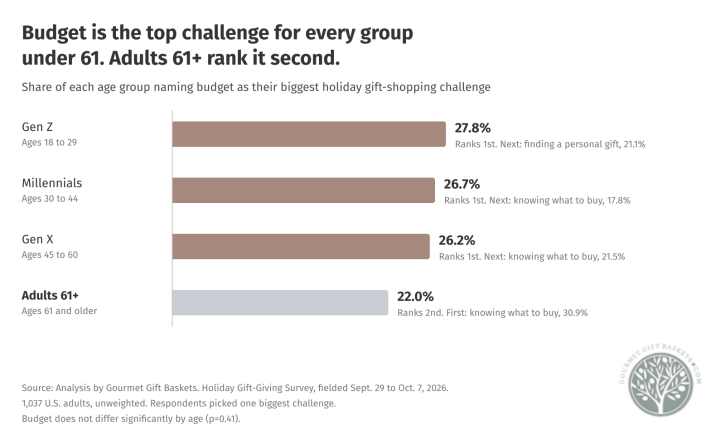
Adults 61+ were the most likely to say knowing what the recipient would genuinely like is their biggest holiday gift-shopping challenge: 30.9%, nearly twice Gen Z’s 16.5%. The share rose with each older group, from Millennials (17.8%) to Gen X (21.5%) to adults 61+
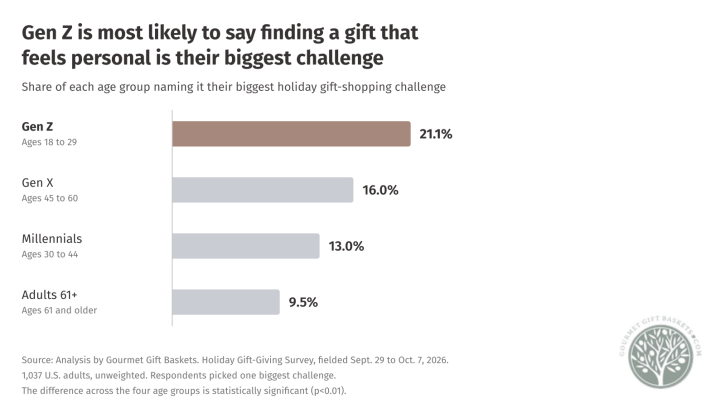
Gen Z was the most likely to say finding a gift that feels personal is their biggest holiday gift-shopping challenge: 21.1%. That compares with 16.0% of Gen X, 13.0% of Millennials and 9.5% of adults 61+, the lowest of any group. The four-group difference was statistically significant.
Millennials (23.3%) and Gen Z (18.8%) were the most likely to name a logistical issue as their biggest holiday gift-shopping challenge: finding time to shop, on-time delivery or a far-away recipient. Gen X was at 15.3% and adults 61+ at 5.6%, so Millennials were more than four times as likely as the oldest group.
Adults 61+ were the most likely to say holiday gift shopping is not challenging at all: 13.9%, compared with 4.5% to 6.5% of younger groups. That is about double Gen X’s rate and about three times the rate of Millennials and Gen Z.
Four-group differences were significant for knowing recipients’ preferences, personalization, combined logistics and reporting no shopping challenge.
Gift Basket Buying Statistics by Age
Who selects a gift basket for someone who is difficult to buy for?
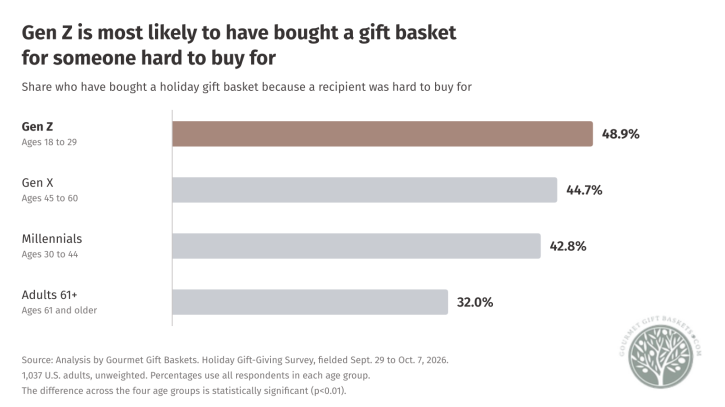
Gen Z had the highest reported rate of buying a holiday gift basket because a recipient was difficult to buy for, while respondents 61 and older had the lowest.
About half of Gen Z (48.9%) said they had bought one for that reason, compared with 44.7% of Gen X, 42.8% of Millennials and 32.0% of respondents 61 and older.
Which age group is more likely to consider buying a gift basket?
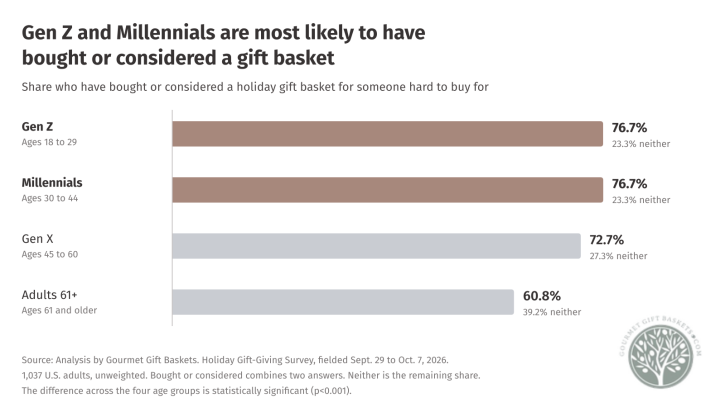
Counting those who had considered one, 76.7% of both Gen Z and Millennials and 72.7% of Gen X had bought or considered a basket, compared with 60.8% of the oldest group.
In which situations are each generation most likely to buy someone a gift basket?
Thank-you gifts
Gen Z had the highest share selecting a thank-you gift for a host, teacher, colleague, client or service provider: 38.3%, compared with 18.4% of respondents 61 and older.
Last-minute gifts
Millennials (33.2%) and Gen Z (30.1%) were more likely than the oldest group (14.8%) to select needing a gift quickly or shopping at the last minute.
One gift for a household or family
Respondents 61 and older had the highest share selecting one gift for a household or family: 41.8%, compared with 25.6% of Gen Z. One basket covers several people at once, which may make shopping simpler and possibly less costly. The survey did not ask respondents why they chose it.
Hard-to-buy-for recipients
Gen X (34.9%) and the oldest group (30.9%) selected a difficult-to-buy-for recipient more often than Gen Z (21.1%).
Older Adults Are More Likely to Call Themselves Hard to Buy For
Although respondents 61 and older were least likely to identify someone else as difficult to shop for, they were the most likely to describe themselves that way.
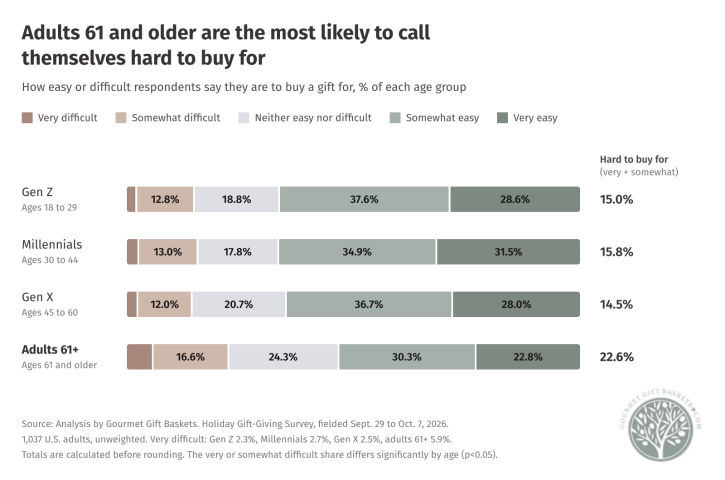
Among the oldest group, 22.6% said they were somewhat or very difficult to buy a gift for, compared with 15.0% of Gen Z, 15.8% of Millennials and 14.5% of Gen X. Just over half of respondents 61 and older (53.1%) called themselves somewhat or very easy to buy for, compared with 64.7% to 66.4% of younger groups. Another 24.3% of the oldest group chose “neither easy nor difficult.”
The four-group difference in the combined “somewhat or very difficult” measure was statistically significant. The Gen Z–61-and-older comparison alone was not.
What the Age Divide Reveals About Holiday Gift Givers
The findings suggest that gift givers face different challenges depending on their age, from making time to shop to figuring out what someone would genuinely enjoy. The common thread between generations is uncertainty, but its form differs: younger shoppers more often struggle with getting gifts bought and delivered, while older shoppers more often struggle with knowing what to choose. These findings reflect respondents’ reported experiences and preferences, not verified purchases.
Methodology
Survey and response quality
Gourmet Gift Baskets commissioned the Holiday Gift-Giving Survey, which PureLinq designed and analyzed. It was fielded September 29–October 7, 2026, and included 1,037 complete responses from U.S. adults. Survey findings appear in The Hard-to-Buy-For Report.
All 1,037 respondents passed the attention check. The survey export separately marked 149 responses with a response-quality flag; those responses were retained in this analysis. Results were not weighted to represent the U.S. adult population. Findings describe respondents’ reported experiences and perceptions, not purchase records.
Age groups and sample sizes
For this analysis, respondents were grouped by self-reported age: Gen Z (18–29, n=133), Millennials (30–44, n=292), Gen X (45–60, n=275) and adults 61 and older (n=337). The oldest group is labeled by age rather than generation and includes 20 respondents aged 81 or older.
Conventional population margins of sampling error are not reported here because probability-based recruitment has not been established in the available survey documentation.
Statistical comparisons
Pearson chi-square tests assessed whether the share selecting an answer or combined measure differed across the four age groups. “Statistically significant” indicates p < 0.05. Tests were not adjusted for multiple comparisons, so some apparent differences may reflect chance. A significant four-group result does not establish which individual groups differ. Pairwise comparisons were not tested except where noted.
Respondents could select up to three difficult-recipient categories and multiple answers for basket-buying situations and suitable recipients, so percentages for those questions can total more than 100%. Each percentage uses all respondents in the relevant age group.