The contrast offers a useful perspective on holiday gifting: being easy to please does not necessarily make choosing gifts for others easy. It does not prove that respondents underestimate their own difficulty. The survey asked people to rate themselves and separately identify categories of difficult recipients; it did not ask their friends or relatives to assess them.
“Someone who already seems to have everything” was the most frequently selected difficult recipient, at 28.7%. Children or teenagers followed at 24.6%, with a spouse or romantic partner close behind at 23.4%.
The challenge varied across age groups. Parents or grandparents were the most difficult recipient category for both Gen Z (33.1%) and Millennials (30.1%). Among Boomers, only 5.6% chose that category; someone who seems to have everything led at 35.0%.
Who is hardest to buy for shifts with life stage
Share of each generation naming each recipient as difficult to buy for
Gender differences were also notable. Men were about twice as likely as women to identify friends as difficult recipients (25.5% vs. 12.3%). Women were more likely to select someone who has everything (33.8%) than men (22.3%).
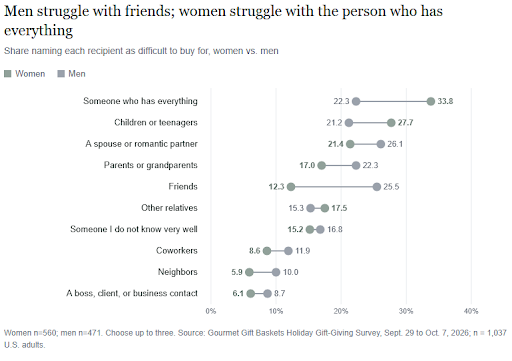
These comparisons describe which categories respondents selected, not how difficult a particular recipient is when someone actually shops for them. The survey did not establish whether every respondent buys gifts for every category.
Households With Children Face a Wider Gift-Shopping Challenge
Respondents with children under 18 at home were particularly likely to identify difficult recipients. Some 95.2% named at least one, compared with 85.1% of respondents without children at home.
Children or teenagers topped the list within households with children, selected by 37.9%. A spouse or partner followed at 30.0%, ahead of someone who seems to have everything at 29.0%. Among respondents without children at home, 19.4% selected children or teenagers and 21.1% selected a spouse or partner.
The difference was not primarily about budget. Staying within budget was the biggest challenge for 24.5% of respondents with children at home and 25.5% without them. The sharper contrast was in whom they struggled to buy for and whether they had used gift baskets for difficult recipients.
Some 56.2% of respondents with children at home had bought a holiday gift basket because a recipient was difficult to buy for, compared with 34.9% without children. Including those who had considered a basket raised those figures to 84.8% and 64.7%, respectively. The survey does not establish who received those baskets or whether household responsibilities explain the difference.
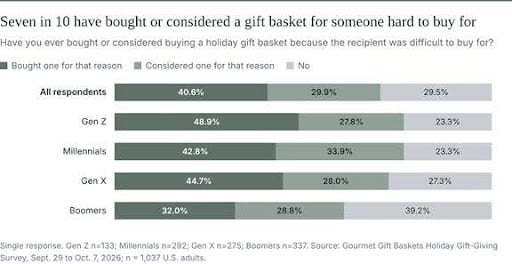
Seven in 10 Have Bought or Considered a Basket for a Difficult Recipient
Gift baskets already play a role in navigating difficult holiday purchases. Overall, 40.6% of respondents had bought a holiday gift basket specifically because the recipient was difficult to buy for. Another 29.9% had considered doing so, bringing the total to 70.5%.
Younger respondents were more likely to report a purchase for this reason. Among Gen Z, 48.9% had bought a basket for a difficult recipient, compared with 32.0% of Boomers. Millennials and Gen X fell between those groups, at 42.8% and 44.7%.
Household income also tracked with this reported behavior. Among respondents in households earning under $25,000, 31.8% had bought a basket for a difficult recipient. That share was 48.3% among households earning 75,000–99,999 and 57.4% among households earning 100,000–149,999. It was slightly lower (52.3%) in the combined $150,000-or-more group.
These figures measure purchases for one specific reason, not overall gift-basket purchasing. They also distinguish completed purchases from consideration: seven in 10 have bought or considered a basket, but four in 10 have actually bought one for this purpose.
Gift Baskets Offer More Than Last-Minute Convenience
When respondents considered situations in which they would buy a holiday gift basket, the leading answers were about the kind of gift they wanted to give.
Wanting something that feels more special than a gift card led at 33.3%, nearly tied with sending one gift to a household or family at 32.8%. Shopping for a difficult recipient followed at 29.2%, while 26.0% chose something shareable. 24.8% said they needed a gift quickly or were shopping at the last minute.
Age groups pointed to different uses. Millennials selected last-minute shopping at 33.2% and Gen Z at 30.1%, compared with 14.8% of Boomers. Boomers were most likely to send one gift to a household (41.8%), compared with 25.6% of Gen Z.
Age groups pointed to different uses. 33.2% of Millennials and 30.1% of Gen Z selected last-minute shopping, compared with 14.8% of Boomers. Sending one gift to a household was most common among Boomers (41.8%), versus 25.6% among Gen Z.
These are stated purchase situations, not measured sales or confirmed plans for the coming holiday season.
Gift Baskets Are Also Seen as Gifts of Care and Support
The most frequently selected recipient for a holiday gift basket was someone difficult to buy for (37.8%). The next most common answer was someone who is sick, grieving, or going through a difficult time (34.1%).
Friends, neighbors, and hosts of holiday gatherings each drew about one-third of respondents. Teachers or childcare providers and a boss, client, or business contact each accounted for 30.6% of responses. A spouse or romantic partner ranked last among named recipients, at 12.2%.
Women were substantially more likely than men to see baskets as suited to someone sick, grieving, or facing difficulties: 43.2% versus 23.4%. Boomers also selected this recipient more often than Gen Z respondents, at 42.7% versus 24.1%.
The findings broaden the holiday basket story beyond professional thank-yous and difficult shopping lists. Respondents also see baskets as appropriate for acknowledging someone’s circumstances and offering support. That is perceived suitability, however, not evidence of how often baskets are given in those situations. Price Matters, but Recipient Fit Matters More When Combined
When choosing a holiday gift basket, budget or value was the most important individual factor, selected by 23.0%.
Matching the recipient’s tastes was selected by 17.6%, and making the basket feel personalized by 16.9%. Together, those two recipient-fit answers accounted for 34.5%—more than budget/value, gourmet quality, festive appearance, or ordering convenience individually.
High-quality or gourmet products ranked highest at 12.2%, followed by attractive, festive presentation at 10.9%. Easy ordering and sending ranked 8.5%, while having enough items to share ranked 5.6%.
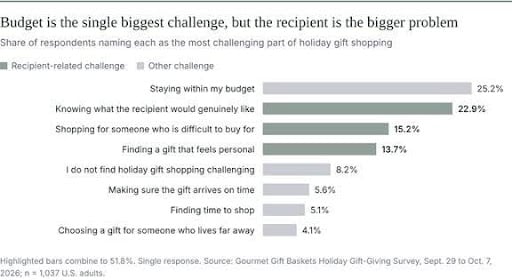
The distinction is important. A shareable basket can help in a specific gifting situation without making shareability the shopper’s top selection factor. Likewise, convenience may bring a shopper to the category, while the recipient’s tastes determine which basket feels right.
The Gifting Opportunity: Make the Choice Feel Personal
The survey suggests the hardest part of holiday shopping isn't finding something to buy. It is finding something that feels right for the person receiving it. Budget remains important, but when you combine those preferences, knowing someone’s tastes and choosing a gift that feels personal matters more.
Gift baskets fit several situations respondents described: sending a gift to a family, thanking a host, shopping for someone who seems to have everything, or showing support during a difficult time. Their appeal is not just about saving time. It is also about finding a gift that suits the person and the occasion.
The broader takeaway goes beyond baskets. Shoppers want their gift to reflect thought for the recipient, not just another name crossed off the list.
Methodology
Gourmet Gift Baskets commissioned this survey of U.S. adults about winter-holiday gift shopping. PureLinq designed the survey and conducted the analysis. The survey was fielded September 29–October 7, 2026, and included 1,037 complete responses. All included respondents passed an attention check. The survey platform’s automated response-quality flag marked 149 responses for review; the full results report states that removing those responses changed no headline figure by more than one percentage point, so all 1,037 were retained.
The survey measured self-reported shopping challenges, perceived difficulty as a recipient, difficult recipient categories, and holiday gift-basket experiences and preferences. Multiple-response answers were counted independently, so their percentages may exceed 100%. Combined measures count respondents selecting the relevant options; single-response categories can be combined without overlap.
Age groups follow the report’s definitions: Gen Z, ages 18–29; Millennials, 30–44; Gen X, 45–60; and Boomers, 61 or older. Their sample sizes were 133, 292, 275, and 337, respectively. Gender comparisons include 560 women and 471 men; six respondents with other gender responses remain included in overall results.
Results were not weighted to represent the U.S. adult population, and the sample skews older. Subgroup comparisons are unadjusted and may reflect overlapping factors such as age, income, gender, and children in the household. Smaller groups, particularly Gen Z and households earning $150,000 or more, should be interpreted cautiously. The findings describe respondents’ perceptions and recollections, not purchase records, and stated willingness to buy does not establish a future purchase.