Across more than two millennia, how people express sympathy has changed in both form and logic. The form has moved from papyrus letters and black-edged Victorian stationery to commercial gift baskets and AI-drafted texts. The deeper shift is in the logic of consolation. Early condolences tried to steer the mourner toward accepting a divine or philosophical order. Modern ones simply try to meet the mourner in their pain, without explanation or resolution.
A short list of constants survives across every era: the acknowledgment that words fail, the reaffirmation of a shared bond, the avoidance of the word "death," and the central role of memory. A new report by Gourmet Gift Baskets traces the evolution period by period, anchors each era in real letters and poems, and analyzes what the modern sympathy market and the messages people actually send reveal about consolation today.
Key Takeaways
- Over two millennia, the sender's task has shifted from correcting the mourner's grief to simply being present, a shift visible in modern cards, where advice-giving now appears in just 1 of 100 cards.
- A few conventions have held across every era, none more consistently than the refusal to name death itself, which appears zero times across the major sympathy-card studies from 1977 to 2022.
- Grief researchers, card publishers, and buyers now converge on the same formula of presence and memory over explanation, and buyers back it decisively, choosing one twelve-word message nearly 40% of the time at Gourmet Gift Baskets.
The Big Picture in Literature
How much a culture talks about grief and sympathy shifts over time, and published books offer one rough proxy for it. Charting how often the words 'grief,' 'sympathy,' and 'sorrow' appear in English-language literature from 1800 to the present shows a clear rise, fall, and return. It maps closely onto the shifting attitudes toward mourning that the rest of this report traces through real letters.
A Google Ngram analysis of digitized book corpora from 1800 to the present tracks how often "grief," "sympathy," and "sorrow" appear in published literature.
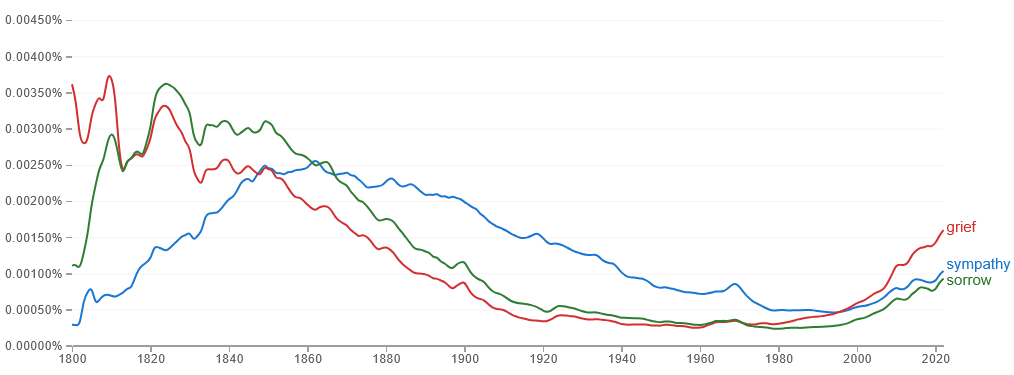
The pattern is clear. "Sorrow" and "grief" ran high in early and mid-19th-century literature, consistent with the Victorian preoccupation with death, mourning ritual, and short lifespans that made loss a constant presence. "Sympathy" rose sharply through the Romantic and Victorian eras, tracking the cultural interest in fellow-feeling and moral sentiment, then declined slowly through the early 20th century. All three terms bottomed out in the mid-20th century, roughly 1960 to 1980, a period when research suggests grief became hidden, privatized, and socially awkward to discuss.
Since the 1980s, "grief" has climbed back toward 19th-century frequencies, while "sympathy" has modestly recovered. The upswing correlates with the growth of grief psychology, bereavement support literature, and the wellness and mental health movement, all of which treat grief as something to be explored, named, and shared rather than privately endured.
Greco-Roman Antiquity (c. 2nd to 4th century AD)
Tone: formulaic resignation. Grief is a condition to be borne with philosophical equanimity, not explored. Condolence letters are thin social gestures that often pivot straight to unrelated business.
Fewer than ten genuine condolence letters survive in the Greco-Roman papyri of Egypt. Scholars read this scarcity as a sign that adult death was so routine it "did not call for special comment," with sympathy letters appearing mainly for the deaths of children. The comfort offered is built from "affective stereotypes," stock phrases asserting the universality of death rather than the particularity of the mourner's pain: "Everything human and mortal is subject to this." "Nothing can be done against such things."
The most celebrated ancient example is the jurist Servius Sulpicius, who wrote to Cicero in 45 BC after the death of Cicero's daughter Tullia. Sulpicius widens the frame of suffering, arguing that great cities such as Corinth have fallen, so one person's death should be borne with equanimity. He closes by reminding Cicero to return to civic duty. The logic is prescriptive. The mourner is told how to feel and instructed to get back to work.
Seneca's consolatory essays, including the Consolation to Marcia, give the fullest philosophical treatment of grief in antiquity. He argues that grief is a correctable cognitive failure, remedied through philosophy and mental preparation: "We should love our dear ones as if their permanence was never promised to us." He also concedes the limits of that project, allowing that philosophy can assuage the wound of grief without fully removing it.
The 18th Century (c. 1630 to 1780)
Tone: civility over content. Sending condolences matters more than what they contain. Not writing is more notable than writing badly.
Between roughly 1630 and 1725, letter-writing manuals across Europe codified condolence as a distinct genre of polite correspondence. The letter became a sign of belonging to polite society, mainly reaffirming the relationship between the sender and the recipient. As Thomas Carr argues, even though the mourner is diminished by loss, "the bond between the bereaved and the letter writer remains unshaken."
Voltaire's correspondence shows the full social range. Writing to a Russian ambassador he barely knew, he leaned on adverbs of intensity to compensate for thin feeling, and scholars note that in such cases the act of sending is the message itself. Writing to his niece after her husband's death, he was intimate and physically present on the page: "I write to you staining the paper with my tears." He was skeptical of Stoic remedies applied too early, noting that philosophy alone cannot remove grief, and preferred the consolation of friendship.
The Victorian Era (c. 1840 to 1900)
Tone: elaborate, ritualized, emotionally intense, and tightly governed. The bereaved were expected to feel deeply but grieve properly.
Victorian Britain turned sympathy into a formal system with its own material culture: black-edged stationery, black-sealed envelopes, mourning wear, and timed mourning periods. The Penny Post of 1840 democratized the condolence letter, and fiction embedded the ritual, signaling a death through the arrival of a black-bordered letter.
The most famous Victorian condolence letter used shared grief as a bridge. Queen Victoria wrote to Mary Todd Lincoln in 1865: "No one can better appreciate than I can, who am myself utterly broken-hearted by the loss of my own beloved Husband, what your sufferings must be." Mary Todd replied that the sympathy meant more coming "from a heart which from its own sorrow, can appreciate the intense grief I now endure."
Emily Dickinson's real condolence letters show the framework compressed into direct fragments. To a mother after her son's death: "my heart breaks, I can say no more." To another correspondent: "Affection wants you to know it is here. Demand it to the utmost." These letters shift the emphasis from explaining death to announcing presence.
19th-Century America
Tone: empathy-first, time-based, emotionally honest. The focus moves from how the bereaved ought to feel toward how they actually feel.
Lincoln's 1862 letter to Fanny McCullough, written after her father was killed in the Civil War, is the most influential model for modern sympathy language. It makes no reference to God or fate. Instead, it offers an empathy-grounded promise and reframes memory as a future gift: "You can not now realize that you will ever feel better. Is not this so? And yet it is a mistake. You are sure to be happy again." The memory of her father, he wrote, would become "a sad sweet feeling in your heart, of a purer and holier sort than you have known before." There is no philosophical widening of the loss and no call to duty, only the steady message: I know how you feel, you will feel better, and your love will change form rather than disappear.
Paul Laurence Dunbar's poem "Sympathy" (1899) breaks from consolation entirely, writing sympathy as solidarity with ongoing suffering: "I know why the caged bird sings.” The speaker does not console but witnesses. Sympathetic presence without a solution would become central to modern condolence language.
Early 20th Century
Tone: humanist, secular, intimate. Consolation finds its footing in nature, science, love, and the endurance of art rather than in theology.
After his ten-year-old daughter, Annie, died in 1851, Charles Darwin wrote at once to his wife, Emma, who was at home. There is no Stoic widening and no civic duty, only raw sorrow, gratitude for a photograph, and love turned toward the surviving spouse: "We must be more and more to each other, my dear wife."
Albert Einstein wrote to Queen Elisabeth of Belgium in 1934 after she lost her husband and, in close succession, her daughter-in-law. His consolation is a secularized Stoicism in which the eternal is not God but art and the renewal of nature: "the springtime sun brings forth new life, and Mozart remains as beautiful and tender as he always was. There is, after all, something eternal that lies beyond the hand of fate."
The 20th Century: Mass Condolence (1963)
Tone: personal, direct, democratized. Grief becomes a civic emotion expressed across all classes and literacy levels.
After President Kennedy's assassination, Jacqueline Kennedy received more than 1.5 million letters of condolence, one of the largest outpourings of private condolence correspondence on record. A sampling of 250 shows sympathy language stripped of Victorian formality: vernacular faith, patriotism, and simple declarations of care. A seven-year-old wrote, "Dear Mrs. Kennedy, I am sorry he is dead." These letters directly precede modern card language, which is short, personal, and emotionally direct.
Modern Sympathy Cards: Content Analysis Over Time
Tone: person-centered, secular-spiritual, validating. Grief is framed as a journey
Commercial cards are the richest longitudinal record of how condolence language has actually changed. Four decades of academic content analysis chart the shift.
|
Study
|
Period
|
Key findings
|
|
Lippy (1977)
|
Late 1970s
|
Core phrase "deepest sympathy." 30% referenced God. 19% "thinking of you." Zero uses of the word "death."
|
|
McGee (1981)
|
1980
|
God references common. Euphemisms for death prevalent. Inadequacy of language explicitly acknowledged.
|
|
Caldwell et al. (1998)
|
1998
|
Messages "less formal, more personal." Religious language shifts from reunion in heaven to faith giving strength.
|
|
McCullough (2019)
|
2019
|
Most common theme: expressions of care. Only 1 advice-giving card in 100 analyzed.
|
|
Calderwood and Alberton (2022)
|
2022
|
Across 170 cards, "love" was the most frequent word (x104). "Thinking/thoughts" (x73), "pray/prayer" (x48), "God" (x39), "time" (x77). Zero uses of "death" or "died."
|

What has changed: the word "death" never appears in these systematic analyses. Religious language has softened from explicit theology toward generic spirituality. "Love" has moved to the center. Continuing-bonds language now dominates, asserting that the deceased persists in memory and love. Care and presence have displaced advice.
What People Actually Want Today
Grief counselors and social work researchers find that the most valued messages share four features: name the specific person who died, offer presence rather than explanation, share a specific memory, and make a concrete offer of help. The clichés flagged as harmful in every study since 1977 include "at least they're not suffering anymore," "everything happens for a reason," and "I know just how you feel."
The academic and counselor guidance describes what bereaved people say they value. Internal selection data from Gourmet Gift Baskets shows what senders actually pick when they attach a note to a gift. In the sympathy category, buyers chose from ten pre-written card messages a total of 7,185 times year-to-date.
Two patterns stand out. First, selections concentrate heavily on a few messages. The single most-selected message, "Holding you close in my thoughts and wishing you peace and healing," was chosen 2,867 times, nearly 40% of all sympathy selections and more than twice as often as any other. The top three messages together account for about 79% of the top 10.
Second, the winning language matches the record. The most-chosen messages lean on the same vocabulary that dominates the 2022 card analysis and the 2,000-year constants: thoughts, peace, healing, comfort, love, strength, and memories. None of the ten messages uses the word "death" or "died." The top message offers presence and a wish, with no explanation, no advice, and no theology, which is exactly the mode grief researchers rank as most helpful. Buyers are, in effect, voting with their selections for presence over prescription.
effect, voting with their selections for presence over prescription.
|
Rank
|
Message
|
Uses
|
Share
|
|
1
|
Holding you close in my thoughts and wishing you peace and healing.
|
2,867
|
40%
|
|
2
|
Please accept my deepest condolences for your loss. I hope you find comfort in the memories you shared and strength in the love surrounding you...
|
1,556
|
22%
|
|
3
|
With deepest sympathy, wishing you comfort and peace during this difficult time.
|
1,285
|
18%
|
|
4
|
Thinking of you and sending heartfelt condolences and strength.
|
457
|
6%
|
|
5
|
May you find comfort in loving memories and support from those around you.
|
323
|
4%
|
|
6
|
Sending love and strength as you navigate this time of loss.
|
258
|
4%
|
|
7
|
With deepest sympathy, may comfort be found in the warmth of memories and the love of those around you...
|
174
|
2%
|
|
8
|
I'm so sorry for your loss. It's never easy to say goodbye, and I hope you can lean on your cherished memories...
|
132
|
2%
|
|
9
|
Sincere condolences are sent during this difficult time. May the love and memories you cherish bring moments of peace and comfort...
|
75
|
1%
|
|
10
|
During this time of sadness, please accept my heartfelt sympathy. Grief can feel overwhelming, but may you find solace in the love and memories...
|
58
|
1%
|
Source: Gourmet Gift Baskets internal card-message selection data, sympathy category, year-to-date. Totals reflect message selections, not orders.
One caveat on interpretation. Selection counts can be shaped by display order and defaults as well as by preference, so the ranking should be read as directional rather than exact.
From Prescription to Presence
The biggest change over 2,000 years is what the sender believes they owe the bereaved. In antiquity and the early modern period, condolence was prescriptive. Philosophical, theological, or social arguments were deployed to redirect the mourner toward acceptance, and the letter's role was to hasten the resolution of grief. By the 19th century, sentimentalist traditions softened this into emotional acknowledgment, though prescription persisted in Victorian etiquette.
By the 20th and 21st centuries, the logic inverted. The sender's job is no longer to direct the mourner's emotions but to meet them where they are. Good condolences now say: I cannot fix this, I will not try to explain it, I am here. Research consistently ranks honest listening and presence as most helpful, and advice, theological explanation, and time-based minimization as most harmful, even when well-intentioned.
The sympathy gift basket sits at the far end of that arc: a product that delivers presence and care without a single word of prescription. Paired with a brief, warm, memory-invoking note, it is the closest modern culture has come to a consensus formula for sympathy:
- Name the loss.
- Offer a memory.
- Promise you are there.
- Do something useful.
Methodology and Sources
Approach
The report combines three kinds of evidence: a chronological reading of primary condolence texts across two millennia, quantitative content analysis of modern sympathy cards, and first-party behavioral data on which messages senders actually choose. The historical reading establishes the long arc from prescription to presence. The content studies show what card language contains. The behavioral data shows what buyers pick. Where the three converge, the finding is treated as strong. Where they diverge, the divergence is noted rather than smoothed over.
Primary historical sources
Letters and poems were drawn from published archival collections and scholarly editions, not from secondary summaries. Key anchors include Servius Sulpicius to Cicero on the death of Tullia (45 BC), Seneca's consolatory essays, Voltaire's correspondence as analyzed in Thomas Carr's work on the condolence letter, Queen Victoria's 1865 letter to Mary Todd Lincoln, several of Emily Dickinson's condolence letters, Lincoln's 1862 letter to Fanny McCullough (Collected Works of Abraham Lincoln, vol. 6), Paul Laurence Dunbar's "Sympathy" (1899), Darwin's 1851 letter to Emma Darwin (Darwin Correspondence Project), and Einstein's 1934 letter to Queen Elisabeth of Belgium (via Krista Tippett, Einstein's God). Surviving Greco-Roman condolence papyri are cited from the scholarly literature on the genre. Where a letter's date or wording is contested in the sources, the standard published version is used, and the ambiguity flagged.
Language-frequency data
The macro trend chart is from the Google Books Ngram Viewer, tracking the terms grief, sympathy, and sorrow in the English corpus from 1800 to the present. Ngram data reflects the frequency of words in published, digitized books. It does not capture speech, letters, or cards, and corpus composition shifts over time, so it should be read as a directional signal of literary attention rather than a precise measure of how people spoke or wrote privately.
Content-analysis studies
Five peer-reviewed content analyses of sympathy cards anchor the modern section: Lippy (1977, Theology Today), McGee (1981, Omega: Journal of Death and Dying), Caldwell, McGee and Pryor (1998, Omega), McCullough (2019, Communication Reports), and Calderwood and Alberton (Omega, first published online January 2022, print issue March 2024). All word counts attributed to the 2022 study, including the absence of the words "death" and "died," are reproduced verbatim from that paper's analysis of 170 Hallmark cards. These studies used different samples, decades, and coding methods, so they are best read as a sequence of snapshots rather than a single continuous dataset.
First-party behavioral data
The buyer-selection table is internal data from Gourmet Gift Baskets, covering the sympathy category in its card-message tool, ranked by year-to-date usage. It records 7,185 selections across ten pre-written templates based on the top 10 choices. The counts reflect message selections rather than completed orders, and selections can be influenced by display order, defaults, and preferences, so the ranking is directional.