The 2026 U.S. fruit market is being shaped by drought, historic freezes, and a potentially record-breaking El Niño — but those forces aren't hitting every category the same way.
When major weather events pile up in the same year, it's easy to assume everything gets worse across the board. That's not what happened in 2026.
Drought covering 60% of the country, a winter of record-breaking cold, and a powerful El Niño on the way have made this one of the most weather-disrupted fruit markets in years.
But some fruits are in the best supply position they've seen in a long time. Others are struggling.
Gourmet Gift Baskets looked at the 2026 outlook for apples, pears, oranges, and berries to understand which is which.
The Weather Behind the Numbers
Three things are driving the 2026 fruit market. Here's a quick look at each.
Drought
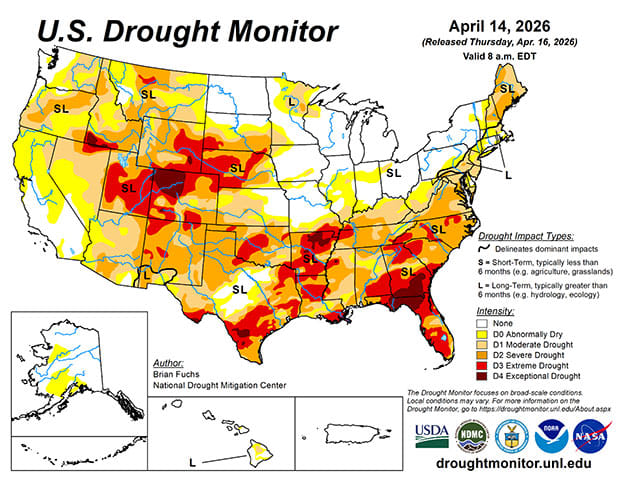
As of early April, 60% of the continental U.S. is in drought, and it's worst in the West, the Plains, and parts of the Southeast, which happen to be where most U.S. fruit is grown.
The American Farm Bureau estimates that over 70% of U.S. fruit and tree nut production by value comes from states currently dealing with drought. One important thing to know: for trees that grow fruit year after year (like apple and pear trees) drought damage can take years to show up. Some orchards never fully bounce back.
Freeze
This past winter brought record cold to growing regions from California to Florida. The worst of it hit in early February, when Orlando fell to 24°F and Jacksonville to 22°F, the coldest temperatures ever recorded on those dates in both cities. The damage varied widely by crop, even within the same state (more on that in the berry section).
El Niño
A strong El Niño (a weather pattern caused by unusually warm ocean temperatures in the Pacific) is expected to develop this summer. NOAA puts the odds at 61% by May-July.
If it arrives as forecast, scientists say 2026, 2027, or both could be the hottest years on record. For fruit growers, that means more heat, less rain, and continued drought through the rest of the year.
How Apples Got to a Record Year
Washington leads a strong national crop
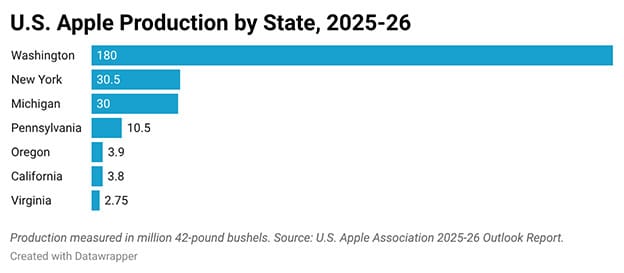
Washington State is on track for its best apple harvest ever.
The U.S. Apple Association forecasts total U.S. production at around 279 million bushels, with Washington alone expected to produce more than 180 million bushels; a record harvest, worth nearly $2.3 billion.
Michigan is up 10% from last year. Oregon is up 40%. Across the major growing states, apple quality is high: good size, clean appearance, and few weather-related problems.
Stemilt Growers, one of Washington's biggest apple producers, said the growing season had "great weather" and that a July heat spike was handled without major damage.
Virginia is the one exception, with its crop forecast down 50%. But given how much Washington dominates the national supply, Virginia's drop isn't likely to change much for buyers.
A favorable moment globally
Internationally, conditions are also working in the U.S. buyers' favor. USDA data shows U.S. apple exports are forecast to rise, while two of the world's biggest apple producers, China and Turkey, are both having lower-than-normal harvests. That means less foreign competition for U.S.-grown apples.
The drought risk that doesn't show up yet
Even in a strong year, drought is a risk worth keeping in mind. Apple trees are perennials — they grow in the same orchards year after year.
Research from USDA shows that drought can stress those trees for years before growers see it in the harvest, and some orchards don't recover at all. This year's numbers look good. What 2027 looks like may depend on whether the Pacific Northwest gets relief from El Niño.
The pear story is one of the biggest turnarounds in recent memory.
2024: one of the worst harvests in 40 years
The 2024 Pacific Northwest pear harvest was a rough one.
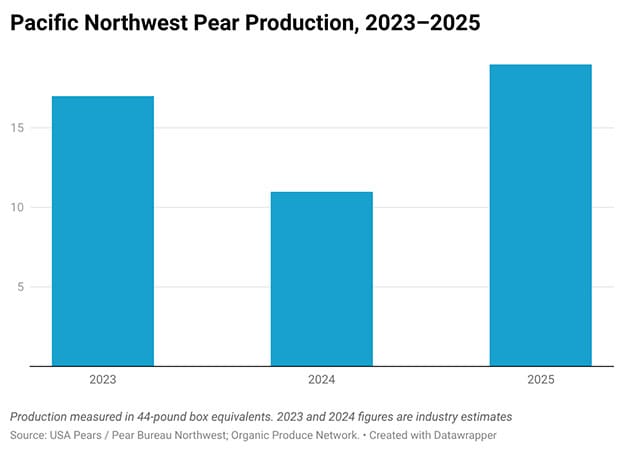
Years of freeze damage had piled up, and the 2024 crop came in 31% below the five-year average. The Washington State Tree Fruit Association called it the worst harvest in some areas in four decades.
There was also a subtler problem: freeze damage can make fruit look worse before it tastes worse. Frost on buds and blossoms can leave pears with rough skin or discoloration, even when the flavor is perfectly fine. That cosmetic damage makes fruit harder to sell.
2025: a sharp rebound
A milder winter in 2024-25 gave orchards a chance to recover — and they did.
USA Pears reported the 2025 harvest at 19 million boxes, up 78% from 2024. Bosc pears were up more than 250%. The USDA ERS credited the Pacific Northwest rebound as the main reason national pear production rose 22%.
That strong supply is expected to carry into 2026, making pears one of the better categories for sourcing this year.
The drought caveat from the apple section applies here, too. 2026 looks good — but 2027 is less certain.
How Florida Oranges Became a California Story
A decade of decline
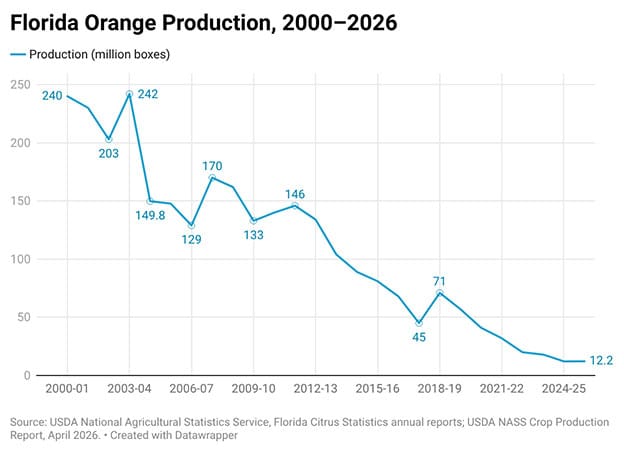
Florida's orange industry has been shrinking for years. ,/p>
Citrus greening disease, spread by a small, invasive bug that causes oranges to fall off the tree before they're ripe, has been devastating Florida's groves for over a decade. Add in hurricane damage, the loss of farmland to development, and the numbers tell a stark story.
USDA's first 2025-26 forecast put Florida orange production at 12 million boxes, a new all-time low. The 2024-25 season was already the worst in over 100 years, and 2025-26 is on pace to be even lower.
The freeze made a bad situation worse
February's record cold made things harder.
Orlando and Jacksonville both hit their lowest February temperatures ever recorded, and oranges that hadn't been picked yet took the hit. Growers had water sprayers ready to help protect the crop, and some fruit was saved, but the cold came at a bad time for an industry that was already stretched thin.
California is holding the national picture together
The good news is that California is picking up the slack.
USDA's March 2026 report put California orange production at 46.5 million boxes, up 3% from last year. The latest USDA revision also bumped Florida's numbers slightly, to 12.2 million boxes, and Florida Citrus Mutual CEO Matt Joyner noted that trees are getting healthier and fruit is getting bigger. The overall national orange supply is stable. But it's increasingly California's story, not Florida's.
Why Berries Are in a Category of Their Own
Up to this point, the pattern has been the same for every fruit: weather causes some trouble, supply adjusts, and the national picture stays stable. Berries break that pattern, and the reason why is one of the most striking findings in this report.
Blueberries: hit hard from two directions
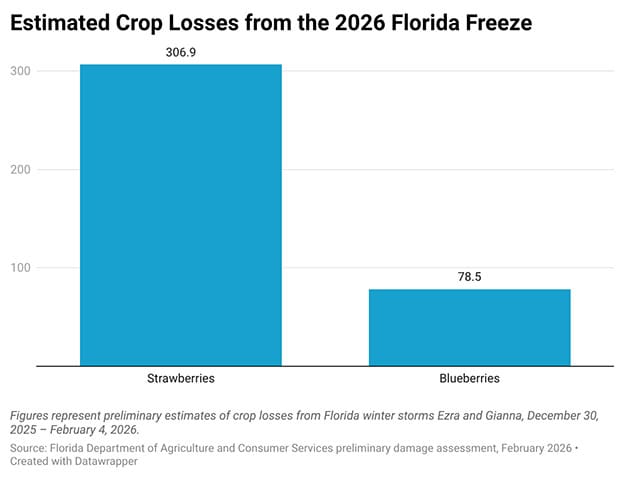
When temperatures dropped below 20°F across parts of Florida in February, the state's blueberry growers lost most of their crop overnight. The Florida Department of Agriculture estimated losses at about 90% of the blueberry harvest, worth around $78.5 million. Kasey Cronquist, president of the U.S. Highbush Blueberry Council, said grower reports from Florida and Georgia were "sobering"; for some farms, the worst season on record.
And it wasn't just Florida.
In Maine, wild blueberry farmers dealt with a different problem: too much rain in the spring, which disrupted pollination, followed by heat and drought in the summer. The 2025 Maine wild blueberry harvest came in at 45 million pounds, about half of what was picked in 2024. Two states, two different weather problems, the same result.
Strawberries: a very different story
Just a few hundred miles south, Florida's strawberry growers went through the exact same February freeze. And yet, the Florida Strawberry Growers Association reported the crop came through "perfectly."
How?
Strawberry growers spray water over their fields during a freeze, which forms a thin layer of ice that actually keeps the plants warm. It's counterintuitive, but it works. The association also said cooler temperatures made strawberries taste better, sweeter, and more flavorful than usual.
What to expect going forward
The Packer's 2026 berry report notes that Georgia's blueberry season is looking strong, and that buying from multiple growing regions should help fill some gaps. New strawberry varieties are also making the category more consistent. Still, blueberries are the most weather-exposed fruit in this report: buyers should expect tighter supply and higher prices as the year goes on.
What Comes Next
The strongest supply categories heading into 2026 — apples and pears — are both concentrated in the Pacific Northwest, the region currently under the most drought stress. The weakest — blueberries — took hits in two separate regions from two separate weather events. Oranges are stable, but only because California is compensating for Florida's ongoing decline.
What ties all of it together is what's still developing.
NOAA forecasts a 61% chance that El Niño will develop by summer, and it could be among the strongest on record. If that happens, scientists say 2026 or 2027 (or both) could break global temperature records. For fruit, that means more heat, less rain, and more stress on crops through harvest season.
Sources
Government & Federal
Industry Associations
Trade Publications
News